
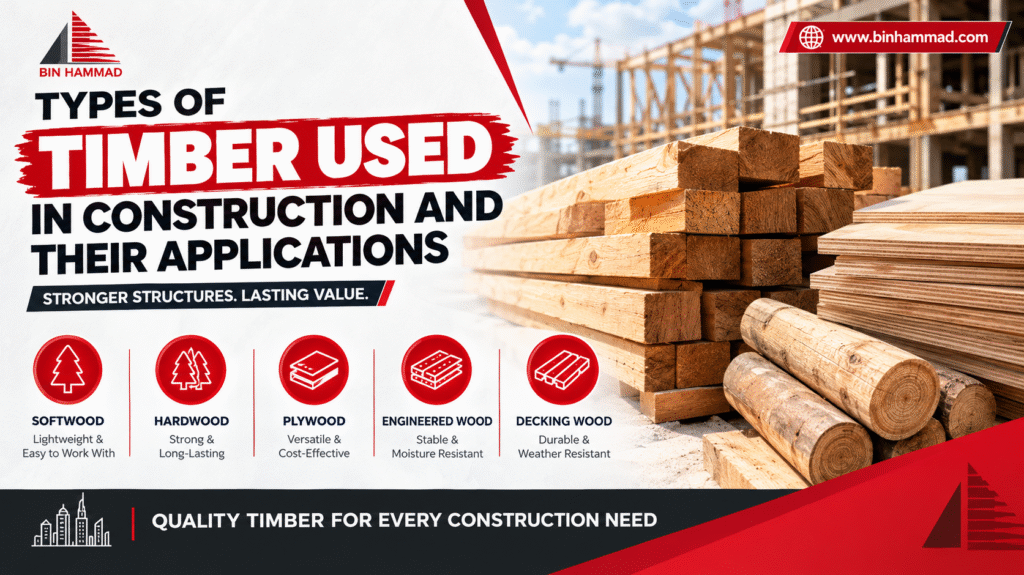
Timber remains an important material in construction, woodworking, and building projects. It can be used for structural components, temporary works, joinery, outdoor applications, and other purposes depending on the timber species, dimensions, treatment, and project requirements. However, not every type of wood is suitable for every application. Understanding the differences between timber options helps builders, contractors, carpenters, and procurement teams select materials that meet their project’s needs.
When researching the types of timber used in construction, it is important to consider more than appearance or price. Strength, durability, moisture exposure, treatment, dimensions, and intended use all influence the final decision.
For construction and timber requirements in the UAE, BIN HAMMAD TRADING ENTERPRISES LLC lists a range of timber and plywood products, including Kapur Tanalised, Mixed Keuring, Pure Tualang, and Bakau Pile. Reviewing the available products alongside the project’s technical requirements can help buyers identify suitable materials for their applications.
Why Is Timber Used in Construction?
Timber is used in construction because it can be cut, shaped, and incorporated into different types of building work. Its suitability depends on the species, grade, condition, and way it is prepared and installed.
Common reasons for using timber include:
- Versatility: Different timber products can serve different construction, woodworking, and outdoor applications.
- Workability: Many timber products can be cut and shaped using suitable tools.
- Range of options: Buyers can select from different species, dimensions, and treatments according to the project.
- Appearance: Natural wood grain can suit visible architectural and interior applications.
- Application-specific selection: Some timber products are intended for particular environments or construction uses.
For structural applications, timber must meet the relevant design requirements. Species names alone do not establish load-bearing capacity, so grade, dimensions, moisture condition, and technical specifications should always be checked.
Different Types of Timber Used in Construction
Timber can be classified by species, physical properties, and intended application. The following sections explain common timber categories and introduce products listed by BIN HAMMAD TRADING ENTERPRISES LLC.
1. Hardwood Timber
Hardwood comes from broad-leaved trees. Depending on the species, it may offer properties suitable for demanding woodworking, joinery, flooring, or construction applications.
Hardwoods vary considerably in density, durability, workability, and resistance to environmental conditions. Therefore, the term “hardwood” should not be treated as a guarantee that a product is suitable for every heavy-duty or outdoor application.
Common applications may include:
- Joinery and woodworking
- Furniture and interior components
- Selected structural applications where specifications permit
- Outdoor projects using an appropriate species and treatment
Before purchasing hardwood for construction, confirm the species, grade, dimensions, moisture condition, and intended use.
2. Softwood Timber
Softwood generally comes from coniferous trees, such as pine, spruce, and fir. Many softwood products are used for framing, temporary works, carpentry, and general construction, depending on their grade and treatment.
Softwood is not automatically weaker or less suitable than hardwood. The correct comparison depends on the properties of the particular product and the requirements of the application.
Common applications may include:
- Framing and carpentry
- Temporary construction components
- Roof and wall assemblies where specified
- General woodworking
For load-bearing use, confirm that the timber has the appropriate grade and documented capacity for the intended design.
3. Treated Timber
Treated timber has undergone a process intended to improve its performance against specific environmental or biological risks. The treatment required depends on whether the timber will be exposed to moisture, insects, decay, or outdoor conditions.
Treatment does not make every timber product suitable for every environment. Buyers should confirm which treatment has been applied, what protection it is intended to provide, and whether it is appropriate for the installation.
Common applications may include:
- Outdoor timber components
- Selected construction and landscaping uses
- Projects where protection against identified environmental risks is required
BIN HAMMAD TRADING ENTERPRISES LLC lists Kapur Tanalised timber. Buyers should review the product information and confirm the treatment details and suitability for their specific application.
4. Piling Timber
Timber piles are used in certain foundation, ground-support, and marine-related applications, depending on the project design and site conditions. The selected pile must be suitable for the ground conditions, loading, exposure, and installation method.
Piling timber should not be selected based only on its size or species name. Its condition, dimensions, required durability, and engineering specifications must be verified.
Potential applications include:
- Specified foundation systems
- Selected ground-support applications
- Marine or waterfront projects where the timber is approved for the intended use
BIN HAMMAD TRADING ENTERPRISES LLC lists Bakau Pile among its timber products. Confirm the available dimensions and suitability with the supplier and project engineer before use.
5. Mixed Keuring Timber
Mixed Keuring is a timber product listed by BIN HAMMAD TRADING ENTERPRISES LLC. Its suitability for a construction project depends on the product’s actual specifications, grade, dimensions, and intended application.
When assessing this option, buyers should request the information needed to determine whether it meets the project’s requirements rather than assuming that a species or trade name alone establishes its performance.
Before purchase, check:
- Available dimensions and lengths
- Timber grade and condition
- Intended application
- Moisture condition and storage requirements
- Any applicable technical documentation
Review the Mixed Keuring timber product for product-specific information before including it in a project order.
6. Pure Tualang Timber
Pure Tualang is another timber product listed on the BIN HAMMAD TRADING ENTERPRISES LLC website. As with other timber options, its appropriate use should be determined from verified product details and the requirements of the project.
Contractors and woodworking professionals should establish whether the available timber is suitable for the required dimensions, finish, exposure conditions, and structural or non-structural purpose.
Potential considerations include:
- Required strength and grade
- Dimensions and cutting requirements
- Exposure to moisture or outdoor conditions
- Intended use in construction or woodworking
- Installation and maintenance requirements
You can review the Pure Tualang timber product and confirm its specifications before purchasing.
Timber Types Compared by Application
The table below provides a general comparison of timber categories. The listed uses are typical examples, not a guarantee that every product within a category is suitable for each application.
| Timber type | Common applications | Key selection consideration |
| Hardwood | Joinery, furniture, selected construction work | Species, grade, durability, and workability |
| Softwood | Framing, carpentry, temporary works | Structural grade, dimensions, and treatment |
| Treated timber | Selected outdoor and exposed applications | Treatment type and intended level of protection |
| Piling timber | Specified foundation and piling systems | Engineering requirements, ground conditions, and durability |
| Mixed Keuring | Application depends on verified product specifications | Grade, dimensions, condition, and intended use |
| Pure Tualang | Application depends on verified product specifications | Grade, dimensions, exposure, and project suitability |
The best timber is the one that meets the technical requirements of the job. A product suitable for indoor joinery may not be appropriate for ground contact or a load-bearing component.
How to Select the Right Timber for a Construction Project
Selecting timber carefully can help reduce waste, prevent unsuitable material substitutions, and support the intended performance of the finished work.
1. Define the Application
First, determine how the timber will be used. Framing, joinery, temporary works, piling, and outdoor installations may require different material properties.
If the timber is part of a structural system, follow the approved design and specification rather than relying on general product descriptions.
2. Check the Species and Grade
Different species have different characteristics, and individual timber products can vary in grade and condition. Ask the supplier for accurate product identification and supporting details where needed.
For structural use, verify the grade and design properties required by the engineer or applicable standards.
3. Consider Moisture and Exposure
Timber may change dimension as its moisture content changes. Prolonged exposure to unsuitable conditions can also contribute to deterioration.
Determine whether the timber will be used indoors, outdoors, in a humid environment, or in contact with the ground. Confirm that its treatment and intended-use specifications match those conditions.
4. Confirm Dimensions and Quality
Check the required thickness, width, length, and quantity before placing an order. Inspect timber for visible defects, damage, warping, splitting, and other conditions that could affect its intended use.
Acceptance criteria should reflect the application and relevant product specifications.
5. Review Treatment and Maintenance Requirements
Where treated timber is required, verify the treatment details and intended protection. Follow the manufacturer’s guidance for handling, installation, cutting, and maintenance.
Do not assume that all treated timber offers the same level of protection.
6. Compare Products and Quotations
When comparing timber suppliers in the UAE, request quotations using the same specifications. Compare the species or product identification, dimensions, grade, treatment, quantity, delivery arrangements, and relevant documentation.
A lower price is not necessarily better value if the material does not meet the project’s requirements.
Timber and Plywood Products from BIN HAMMAD TRADING ENTERPRISES LLC
BIN HAMMAD TRADING ENTERPRISES LLC offers a Timbers & Plywoods product category for buyers reviewing timber-related materials for construction and other applications.
The listed range includes several timber products that buyers can investigate according to their needs:
- Kapur Tanalised: Review the product details to confirm the treatment and suitable applications.
- Bakau Pile: Check the product specifications for piling-related requirements.
- Mixed Keuring: Confirm grade, dimensions, and intended use before ordering.
- Pure Tualang: Review the available product information to establish whether it meets the project’s requirements.
The company also lists plywood options within its broader timber-related range. Timber and plywood are different material categories, so they should be assessed separately according to the intended application.
For builders, contractors, carpenters, and procurement teams in the UAE, the practical next step is to identify the required product, prepare a specification, and confirm the available details with the supplier before placing an order.
Conclusion
Understanding the types of timber used in construction helps contractors and buyers match materials to the needs of each project. Hardwood, softwood, treated timber, and piling timber can serve different purposes, but suitability depends on the product’s actual properties, grade, dimensions, treatment, and installation environment.
Before purchasing, define the application, check the technical requirements, consider moisture and exposure, and verify the product details. These steps are particularly important when timber will be used in structural or ground-contact applications.
BIN HAMMAD TRADING ENTERPRISES LLC lists timber products including Kapur Tanalised, Bakau Pile, Mixed Keuring, and Pure Tualang. Reviewing these options against project specifications can help buyers identify relevant materials for construction and woodworking requirements in the UAE.
FAQs:
Common categories include hardwood, softwood, treated timber, and timber selected for specialised uses such as piling. The appropriate type depends on the application, grade, dimensions, and exposure conditions.
Hardwood generally comes from broad-leaved trees, while softwood typically comes from coniferous trees. Their properties vary by species, so neither category is automatically suitable for every construction application.
The correct timber depends on the exposure conditions, species, treatment, and project requirements. Confirm that the selected product is specified for outdoor use and the expected moisture or ground-contact conditions.
Treatment may help protect timber against particular risks, such as insect damage or decay. The type of protection depends on the treatment applied, so buyers should check the product documentation before use.
Check the timber identification, grade, dimensions, moisture condition, visible defects, treatment, intended use, and any required technical documentation.
No. Structural suitability depends on the species, grade, dimensions, condition, and verified design properties. The material must meet the project’s engineering requirements.
Piling timber may be used in specified foundation or ground-support systems where the design permits it. Selection depends on ground conditions, loads, durability requirements, and installation methods.
The supplied product list includes Kapur Tanalised, Mixed Keuring, Pure Tualang, and Bakau Pile. Buyers should review the individual product pages and confirm specifications for their intended applications.
Compare suppliers using consistent specifications. Review product identification, grade, dimensions, treatment, technical documentation, quantities, and delivery arrangements before making a purchasing decision.
No. Different projects have different requirements for strength, durability, moisture resistance, dimensions, and appearance. Select timber based on the application and verified product specifications.
