
What Are the Types of Power Tools Used in Construction?
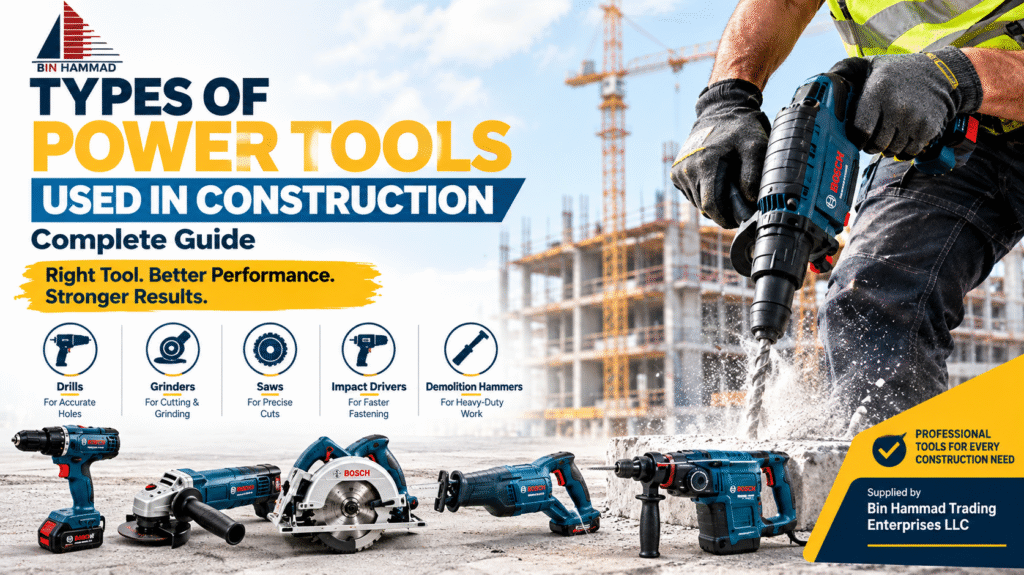
The types of power tools used in construction include drills, grinders, circular saws, impact drivers, rotary hammers, demolition hammers, angle grinders, sanders, and other electrically or battery-powered equipment. These tools help construction professionals complete drilling, cutting, grinding, fastening, polishing, demolition, and installation work faster and with greater consistency.
Construction projects often involve repetitive and demanding tasks. Therefore, workers need reliable tools that can handle different materials and working conditions. While hand tools remain important, power tools can significantly improve productivity when workers select and use them correctly.
For contractors, builders, engineers, maintenance teams, and industrial buyers in the UAE, choosing the right power tool also requires attention to tool performance, application, durability, safety, and available accessories.
Bin Hammad Trading Enterprises LLC supplies power tools and industrial equipment for construction, maintenance, and other professional applications. Buyers can explore the company’s range and product solutions through the Bin Hammad.
Why Are Power Tools Important in Construction?
Construction work requires accuracy, speed, and physical effort. Workers may need to drill hundreds of holes, cut different materials, tighten fasteners, grind metal surfaces, or remove concrete during a single project.
Power tools make these tasks more manageable.
For example, a worker can use a drill to create holes, an angle grinder to cut or grind metal, and a rotary hammer to drill into concrete. Each tool performs a specific task and helps reduce the physical effort required compared with using a conventional hand tool.
Power tools can help construction teams:
- Complete repetitive work faster
- Improve drilling and cutting efficiency
- Handle harder materials
- Improve consistency
- Reduce manual effort
- Perform specialised tasks
- Complete installation work more efficiently
- Support large-scale construction projects
However, every power tool has a specific purpose. Using the wrong tool can reduce productivity, damage the material, or create unnecessary safety risks.
That is why understanding the different types of power tools used in construction helps buyers and workers select the right equipment for each job.
1. Power Drills
Power drills are among the most commonly used construction tools.
Workers use drills to create holes in materials such as:
- Wood
- Metal
- Plastic
- Masonry
- Some concrete applications
A standard drill primarily uses rotational force. Depending on the model, workers can adjust speed and use different drill bits for different materials.
Construction professionals use power drills for installation, fabrication, maintenance, furniture work, electrical work, and general construction tasks.
For example, electricians may use drills to create openings for cables and fittings, while carpenters may use them for drilling and fastening applications.
2. Hammer Drills
Hammer drills combine rotational movement with a hammering action.
This feature helps workers drill into masonry and lighter concrete more effectively than a standard drill.
Hammer drills commonly support applications such as:
- Drilling masonry
- Installing wall plugs
- Creating anchor holes
- Installing brackets
- Light concrete drilling
- General renovation work
The operator can normally switch between drilling and hammer-drilling modes, depending on the tool design.
For heavier concrete applications, however, a rotary hammer usually provides greater impact energy and better performance.
If you are selecting a drill for construction work, understanding the differences between drill types can help you choose equipment that matches your application.
3. Rotary Hammers
Rotary hammers are designed for demanding drilling applications, particularly in concrete and masonry.
They use a stronger impact mechanism than a typical hammer drill. Many models also provide different operating modes, including drilling, hammer drilling, and chiselling.
Construction professionals commonly use rotary hammers for:
- Concrete drilling
- Anchor installation
- Masonry drilling
- Chiselling
- Tile removal
- Light demolition
- MEP installation
Rotary hammers often use SDS-Plus or SDS-Max bit systems.
SDS-Plus models suit many everyday construction applications, while SDS-Max tools generally target larger holes and heavier-duty work.
For contractors working regularly with concrete, a rotary hammer can provide a practical combination of impact performance and versatility.
4. Impact Drivers
Impact drivers are compact power tools designed primarily for driving screws, bolts, and other fasteners.
Unlike a standard drill, an impact driver uses a rotational impact mechanism that provides additional torque when driving fasteners.
Construction workers use impact drivers for:
- Driving long screws
- Installing fasteners
- Fixing brackets
- Wood framing
- Metal applications
- General assembly
Their compact size makes them useful when workers need to work in restricted spaces.
However, an impact driver should not automatically replace a drill. The two tools serve different purposes.
A drill offers greater versatility for drilling, while an impact driver specialises in fastening applications.
5. Angle Grinders
Angle grinders are highly versatile tools used for cutting, grinding, cleaning, and surface preparation.
Depending on the disc or accessory, an angle grinder can work with:
- Steel
- Stainless steel
- Masonry
- Concrete
- Stone
- Other suitable materials
Construction workers commonly use angle grinders for:
- Cutting metal
- Grinding welds
- Removing rust
- Surface preparation
- Sharpening suitable tools
- Cutting masonry with the correct accessory
The accessory determines much of the tool’s application.
For example, a cutting disc is designed for cutting, while a grinding wheel is designed for grinding. Workers should always use accessories that match the tool, material, speed rating, and application.
6. Circular Saws
Circular saws use a rotating circular blade to make straight cuts.
Construction professionals commonly use them for cutting:
- Timber
- Plywood
- Boards
- Sheet materials
- Certain plastics
- Other materials when equipped with the correct blade
Circular saws can significantly speed up repetitive cutting tasks.
Cordless models offer greater mobility, while corded models provide continuous operation when a suitable power supply is available.
The blade plays an important role in cutting performance. Workers should choose the correct blade type and tooth configuration for the material.
7. Reciprocating Saws
A reciprocating saw uses a back-and-forth blade movement.
Its design allows workers to make cuts in locations where a circular saw may not fit easily.
Construction and maintenance professionals use reciprocating saws for:
- Cutting pipes
- Removing timber
- Demolition
- Cutting metal
- Removing old fixtures
- Renovation work
The ability to change blades makes the reciprocating saw useful for different materials.
However, workers should select a blade according to the material and cutting task.
8. Jigsaws
Jigsaws use a reciprocating blade and work particularly well when workers need curved or detailed cuts.
They commonly support:
- Wood cutting
- Plastic cutting
- Thin metal cutting
- Curved cuts
- Internal openings
Carpenters, installers, and construction workers can use jigsaws for more detailed cutting work.
The correct blade matters because different blade designs support different materials and finishes.
9. Demolition Hammers
Demolition hammers focus on breaking and removing hard materials.
Unlike many rotary hammers, demolition hammers generally focus on impact rather than drilling.
Workers use them for:
- Breaking concrete
- Removing tiles
- Chiselling masonry
- Demolition
- Removing old flooring
- Breaking hard surfaces
These tools generate significant impact force, so workers should use appropriate PPE and follow safe operating practices.
Demolition hammers also require careful handling because prolonged vibration and heavy tool weight can increase operator fatigue.
10. Sanders
Sanders use abrasive surfaces to smooth, finish, or prepare materials.
Construction and woodworking professionals use different sanding tools depending on the application.
Common sanding tasks include:
- Smoothing wood
- Preparing surfaces for painting
- Removing old finishes
- Smoothing rough edges
- Surface preparation
Different sanders suit different jobs.
For example, an orbital sander can handle general surface finishing, while other specialised sanders target specific applications.
Choosing the correct abrasive also affects the final finish.
11. Heat Guns
Heat guns produce controlled hot air and support various construction and maintenance applications.
Workers can use them for:
- Removing certain coatings
- Softening adhesives
- Shrinking suitable heat-shrink materials
- Bending certain plastics
- Paint-related preparation
Heat guns require careful handling because their working temperatures can become very high.
Workers should keep the hot-air stream away from people, flammable materials, and surfaces that cannot tolerate heat.
12. Concrete Cutters and Core Drills
Concrete cutting and drilling require specialised equipment.
Core drills create larger, controlled holes in concrete, masonry, and other suitable materials.
Construction teams may use them for:
- Pipe penetrations
- Electrical installations
- HVAC installations
- Plumbing
- Structural openings
- MEP work
Core drilling requires careful planning because workers may encounter reinforcement, embedded services, or other obstructions.
For large commercial and industrial projects, the tool selection should match the required hole diameter, depth, material, and drilling method.
Corded vs Cordless Power Tools
Another important difference between power tools involves the power source.
Corded Power Tools
Corded tools connect to an electrical supply and can operate continuously as long as the required power remains available.
They work well for:
- Workshops
- Fixed work areas
- Long-duration applications
- High-use construction tasks
However, power cables can restrict movement. Workers should route cables safely and keep them away from cutting edges, water, and moving equipment.
Cordless Power Tools
Cordless tools use rechargeable batteries.
They provide greater mobility and work particularly well when:
- Workers move around large sites
- Electrical outlets are unavailable
- Teams need quick setup
- Workers perform tasks in different locations
Battery capacity, charging time, tool weight, and spare batteries all matter when selecting cordless equipment.
For professional construction teams, a compatible battery platform can also simplify tool management when multiple cordless tools use the same battery system.
How to Choose the Right Construction Power Tool
Choosing a power tool requires more than looking at its brand or motor power.
Consider the following factors before purchasing.
1. Identify the Material
First, determine what you need to work on.
Concrete, steel, timber, masonry, and plastic require different tools and accessories.
2. Define the Application
Ask what you actually need to do.
Do you need to:
- Drill?
- Cut?
- Grind?
- Fasten?
- Sand?
- Chisel?
- Demolish?
The answer will immediately narrow your options.
3. Check Power and Performance
Compare relevant specifications such as:
- Motor power
- Torque
- Impact energy
- No-load speed
- Impact rate
- Cutting capacity
- Drilling capacity
Do not choose a tool based on one specification alone.
4. Consider Frequency of Use
A homeowner performing occasional repairs may not require the same tool as a contractor using equipment every day.
Professional users should consider durability, ergonomics, serviceability, and long-term operating requirements.
5. Check Tool Weight
Heavy tools can create fatigue during prolonged work.
At the same time, demanding applications may require additional power.
Therefore, find a practical balance between performance and handling.
6. Choose the Correct Accessories
A power tool can only perform correctly when workers use suitable accessories.
Check:
- Blade type
- Drill bit type
- Disc diameter
- Disc speed rating
- Chuck compatibility
- Shank system
- Abrasive type
Always follow the manufacturer’s instructions.
Power Tool Safety in Construction
Power tools can improve productivity, but improper use can create serious hazards.
Construction workers should follow the manufacturer’s operating instructions and site safety requirements.
Inspect Tools Before Use
Check the tool, cable, plug, battery, guards, switches, and accessories before operation.
Do not use damaged equipment.
Wear Appropriate PPE
Depending on the application, workers may need:
- Safety glasses
- Face protection
- Hearing protection
- Safety footwear
- Suitable gloves
- Respiratory protection
The required PPE depends on the tool and workplace hazards.
Use the Correct Accessory
Never install an accessory simply because it physically fits the tool.
Confirm that it matches the tool’s specifications and intended application.
Keep Guards in Place
Never remove a required guard to make a tool easier to use.
Guards help protect operators from moving parts, sparks, fragments, and other hazards.
Maintain a Stable Working Position
Keep a firm stance and maintain control of the tool.
Avoid awkward positions that make it difficult to control the equipment.
Manage Dust and Debris
Cutting, grinding, drilling, and demolition can produce dust and airborne particles.
Use appropriate dust-control methods and respiratory protection when required.
Disconnect Before Maintenance
Switch off and disconnect corded tools before changing accessories or performing maintenance. For cordless tools, remove the battery when the manufacturer’s instructions require it.
Common Mistakes When Using Construction Power Tools
Workers can avoid many problems by following a few basic practices.
Using the Wrong Tool
Do not use an angle grinder when a specialised cutting tool provides a safer or more suitable solution.
Using the Wrong Accessory
A drill bit, blade, or disc must match the material and tool.
Applying Excessive Force
Let the tool perform the work.
Excessive pressure can reduce control and increase wear.
Ignoring Tool Specifications
Check maximum speed, capacity, compatibility, and operating instructions before use.
Neglecting Maintenance
Clean tools regularly and inspect accessories.
Replace worn or damaged components according to the manufacturer’s recommendations.
Why Choose Bin Hammad Trading Enterprises LLC for Power Tools?
Finding the right power tool becomes easier when you work with a supplier that understands construction and industrial requirements.
Bin Hammad Trading Enterprises LLC supplies a broad range of industrial tools, power tools, hand tools, construction equipment, hardware, safety products, welding equipment, and related supplies in the UAE.
The right supplier can help buyers consider the application instead of simply choosing the most powerful tool available.
For example, a contractor may need a rotary hammer for concrete drilling, an angle grinder for metal work, an impact driver for fastening, and a circular saw for timber cutting. Each tool serves a different purpose.
You can explore the company’s products and solutions through the Bin Hammad Trading Enterprises LLC website.
You can also learn more about selecting a power tools supplier in the UAE when comparing suppliers for professional and industrial requirements.
For buyers specifically researching power tools in Dubai, the power tools in Dubai guide provides additional information.
If you are interested in Bosch equipment, you can also explore the Bosch power tools guide for more information about the brand and its applications.
Final Thoughts
The types of power tools used in construction vary according to the material, application, project size, and required performance.
Drills help create holes, hammer drills handle masonry and lighter concrete work, rotary hammers support demanding concrete applications, impact drivers handle fastening, and angle grinders support cutting and grinding. Similarly, circular saws, reciprocating saws, jigsaws, sanders, demolition hammers, and specialised concrete tools serve different construction requirements.
Therefore, construction professionals should choose tools based on the actual task rather than simply selecting the most powerful equipment.
For contractors, builders, engineers, maintenance teams, and industrial buyers in the UAE, Bin Hammad Trading Enterprises LLC offers a practical source for power tools and related construction and industrial supplies.
The right combination of tool, accessory, safety equipment, and application knowledge can help construction teams work more efficiently while maintaining better control and safety.
FAQs
Q1. What are the most common power tools used in construction?
Ans. Common construction power tools include drills, hammer drills, rotary hammers, impact drivers, angle grinders, circular saws, reciprocating saws, jigsaws, sanders, and demolition hammers.
Q2. Which power tool is most useful for construction?
Ans. A drill is one of the most versatile construction power tools, but the best tool depends on the task. Contractors may need different tools for drilling, cutting, grinding, fastening, and demolition.
Q3. What is the difference between a drill and a hammer drill?
Ans. A standard drill primarily provides rotational force, while a hammer drill adds a hammering action that helps it drill masonry and lighter concrete.
Q4. What is a rotary hammer used for?
Ans. A rotary hammer is mainly used for drilling and chiselling hard materials such as concrete and masonry. It provides stronger impact action than a typical hammer drill.
Q5. Are cordless power tools suitable for construction?
Ans. Yes. Cordless power tools can provide excellent mobility and convenience. Professional users should consider battery capacity, runtime, charging requirements, and tool performance.
Q6. How do I choose a construction power tool?
Ans. Start by identifying the material and application. Then compare the tool’s power, capacity, speed, weight, accessories, durability, and safety features.
Q7. Are power tools better than hand tools?
Ans. Power tools can complete many repetitive or demanding tasks faster and with less physical effort. However, hand tools remain important for precision work and tasks where power tools are unsuitable.
Q8. Why are power tool accessories important?
Ans. Accessories such as drill bits, blades, grinding wheels, and discs determine what materials and applications a tool can handle. Always select accessories that match the tool and job.
Q9. Where can I buy power tools in the UAE?
Ans. Bin Hammad Trading Enterprises LLC supplies power tools and related industrial and construction equipment in the UAE. Buyers can explore its range according to their application and project requirements.
Q10. What safety precautions should I follow when using power tools?
Ans. Inspect tools before use, choose suitable accessories, use required guards, wear appropriate PPE, maintain good control, manage dust and debris, and follow the manufacturer’s operating instructions.
