
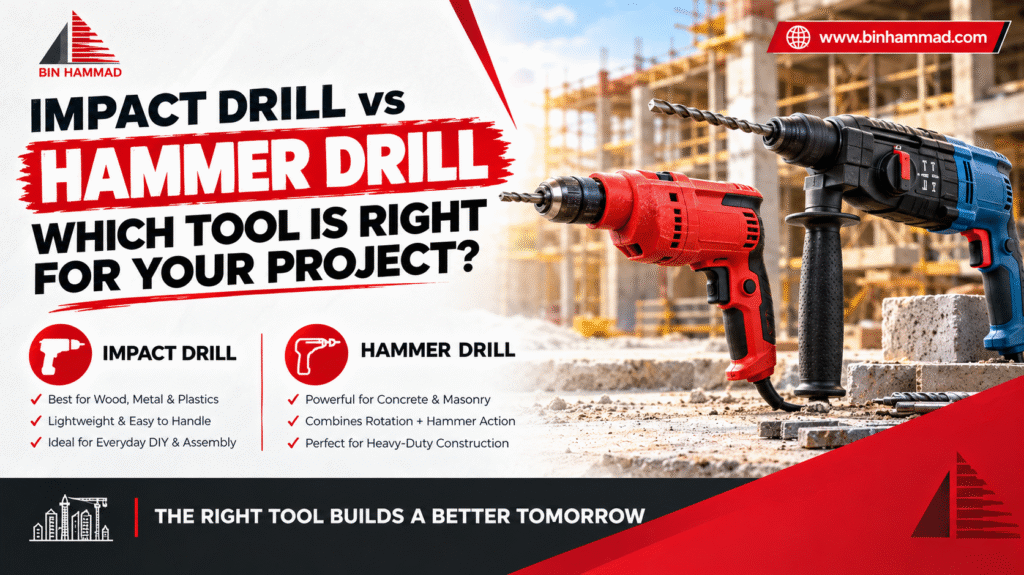
Drilling into different materials requires the right tool for the job. Whether you are installing fixtures, assembling equipment, or working on a construction project, selecting a suitable drill can affect the accuracy, efficiency, and quality of your work. Two tools that are often compared are the impact drill and the hammer drill, but they operate differently and are designed for different tasks.
Understanding impact drill vs hammer drill helps builders, maintenance teams, contractors, and DIY users make a more informed decision. Although both tools provide rotational movement, their impact mechanisms and typical applications differ. Selecting the wrong one may make a task more difficult or lead to an unsuitable result.
For buyers sourcing construction tools and related supplies, BIN HAMMAD TRADING ENTERPRISES LLC provides a range of products for building and industrial applications. This guide explains the differences between impact drills and hammer drills, their uses, and the factors to consider before choosing a tool.
What Is an Impact Drill?
The term impact drill is sometimes used to describe an impact driver, although the two terms can also be used differently by manufacturers and sellers. An impact driver is primarily designed for driving screws, bolts, and other fasteners. It combines rotational force with repeated rotational impacts to help drive fasteners.
Impact drivers are commonly considered for tasks such as:
- Driving screws into suitable materials.
- Fastening components during assembly.
- Installing fixtures that require screws or compatible fasteners.
- Repetitive fastening work where a standard drill may require more effort.
The exact capability depends on the model, its torque, the accessories used, and the fastener involved. Always check the manufacturer’s instructions before using the tool.
Key Features to Consider
When evaluating an impact driver, review its torque rating, speed settings, trigger control, battery or power supply, and compatible bit holder. These details help determine whether the tool is appropriate for the fasteners and materials involved.
An impact driver is not automatically the best option for drilling every type of hole. Confirm that the model and its accessories are designed for the intended task.
What Is a Hammer Drill?
A hammer drill is designed for drilling holes, particularly in hard materials such as masonry and concrete when the tool and drill bit are suitable for the application. It combines rotation with a rapid hammering action directed along the drilling axis.
This hammering action helps the bit work into the material while rotating. Hammer drills are commonly used for tasks such as:
- Drilling holes in suitable masonry surfaces.
- Installing anchors where the specified hole size and depth are required.
- Carrying out building maintenance and installation work.
- Drilling into brick or concrete when the tool’s specifications permit it.
Hammer drills vary in power, operating modes, chuck design, and drilling capacity. Some models allow the hammering function to be switched off for ordinary drilling, but this depends on the specific tool.
Key Features to Consider
Check the drill’s rated capacity for the material, available operating modes, speed control, chuck compatibility, and supported drill-bit types. The manufacturer’s guidance should determine whether a particular model can handle the required material and hole dimensions.
For larger or demanding concrete-drilling jobs, a rotary hammer may be more appropriate than a conventional hammer drill. The correct choice depends on the material, hole size, workload, and tool specifications.
Impact Drill vs Hammer Drill: Key Differences
The main difference is how each tool applies impact force and the type of work it is designed to perform. An impact driver applies rotational impacts that assist fastening, while a hammer drill applies a hammering action along the drilling axis to assist drilling into suitable hard materials.
| Comparison factor | Impact driver | Hammer drill |
| Main purpose | Driving screws and compatible fasteners | Drilling holes, including into suitable masonry |
| Impact action | Rotational impacts | Axial hammering action |
| Common applications | Fastening and assembly | Drilling into brick, masonry, and some concrete |
| Typical accessories | Compatible driver bits and fastening accessories | Suitable drill bits for the material and chuck |
| Concrete drilling | Not the usual first choice for general concrete drilling | Often suitable for smaller holes, within rated capacity |
| Fastener installation | Well suited to many repetitive fastening tasks | Can drive some fasteners only when the model and accessory are suitable |
| Important buying factor | Torque, speed control, and bit compatibility | Drilling capacity, hammer mode, and bit compatibility |
The terms used in product listings can vary. If a supplier describes a product as an “impact drill,” confirm whether it is an impact driver, a conventional hammer drill, or another type of tool before purchasing.
Which Tool Is Right for Your Project?
The best tool depends on what you need to do, rather than which tool sounds more powerful.
Choose an Impact Driver for Fastening Tasks
An impact driver may be suitable when your project involves driving many screws or compatible fasteners. It is commonly useful for assembly, fixing components, and repetitive fastening where controlled and efficient driving is important.
Before using one, check the fastener type, bit compatibility, and required torque. Excessive torque can damage fasteners or the material, so use the appropriate setting and technique when available.
Choose a Hammer Drill for Masonry Drilling
A hammer drill is generally the more appropriate option when you need to make holes in brick or other suitable masonry. Its axial hammering action assists the drill bit as it works into the material.
Before starting, identify the material and confirm the required hole diameter and depth. Select a compatible masonry bit and check that the drill’s rated capacity covers the job.
Consider a Conventional Drill for General Drilling
If your work mainly involves drilling into wood, metal, plastic, or other materials that do not require a hammering action, a conventional drill may be enough. Some hammer drills can also perform ordinary drilling when their hammer mode is switched off.
Always check the material, bit, and operating instructions before use.
Consider a Rotary Hammer for Demanding Concrete Work
For larger holes or more demanding work in concrete, a rotary hammer may be worth considering. It uses a different mechanism from a conventional hammer drill and is designed for heavier drilling applications within its specified capacity.
Do not assume that every hammer drill can handle heavy-duty concrete work. Match the tool to the hole size, material, and expected workload.
Factors to Check Before Buying a Drill
Comparing the tool’s specifications before purchase can help you avoid selecting a model that is unsuitable for the job.
1. Identify the Material
Determine whether you will work with wood, metal, brick, concrete, or another material. Different materials require different bits and drilling methods.
2. Define the Task
Decide whether the main job is fastening, general drilling, masonry drilling, or a combination of tasks. This is one of the most important factors in deciding which tool to buy.
3. Check Power and Capacity
Review the tool’s power rating, torque, speed range, and drilling capacity where applicable. For battery-powered tools, also check battery compatibility and the manufacturer’s stated operating information.
4. Confirm Accessory Compatibility
Make sure the drill accepts the required bits and accessories. A tool’s chuck or bit holder may limit which accessories can be used, so verify compatibility before ordering.
5. Consider Frequency of Use
A tool for occasional maintenance may have different requirements from one used regularly on a construction site. Consider the workload, handling, control, and maintenance instructions when comparing models.
6. Follow Safety Instructions
Use the correct bit, secure the workpiece, and wear appropriate eye protection. Follow the tool manufacturer’s safety guidance, particularly when drilling masonry or concrete, where dust and flying particles may be generated. Check for concealed electrical wiring and pipes before drilling into walls.
Common Mistakes to Avoid
Selecting the wrong tool can slow work and increase the risk of damaging materials or accessories. Avoid these common mistakes:
- Confusing an impact driver with a hammer drill: Their impact mechanisms serve different purposes.
- Using the wrong bit: Match the bit to the material and the tool’s holder.
- Ignoring the tool’s rated capacity: Do not exceed the manufacturer’s stated limits.
- Assuming every hammer drill is suitable for heavy concrete work: Check the drilling capacity and intended application.
- Using excessive force: Let the tool and appropriate bit do the work according to the manufacturer’s instructions.
- Overlooking safety precautions: Secure the work area and use suitable protective equipment.
A clear understanding of the task and the tool’s specifications helps you select equipment that is appropriate for the job.
Tools and Related Products at BIN HAMMAD TRADING ENTERPRISES LLC
BIN HAMMAD TRADING ENTERPRISES LLC supplies products for construction and related work. Buyers comparing tools and accessories should review the company’s available product listings and confirm the intended application, specifications, and current availability before purchasing.
For work involving drilling and fastening, the company’s Air Tacker Gun and Stapler Gun are related fastening-tool listings, although they are not substitutes for an impact driver or hammer drill. The website also lists a Strapping Tool for strapping-related work and Cutting Disc for cutting applications. These products serve different purposes, so select each item according to the task rather than treating them as interchangeable drilling tools.
To review other construction and industrial supplies, visit the company’s Structural Building Materials category. Confirm whether the category contains the specific tool you need, as the listed products above are related accessories or tools for different applications rather than impact drills or hammer drills.
Conclusion
Understanding impact drill vs hammer drill makes it easier to match a tool to the task. An impact driver is primarily designed for driving compatible fasteners, while a hammer drill is intended for drilling holes and can assist with suitable masonry work through its axial hammering action. A conventional drill may be sufficient for general drilling, while more demanding concrete jobs may require a rotary hammer.
Before buying, check the material, application, tool capacity, accessory compatibility, and manufacturer instructions. BIN HAMMAD TRADING ENTERPRISES LLC lists construction-related tools and supplies that buyers can review according to their project needs. Confirm the exact product specifications and availability before placing an order.
FAQs:
An impact driver applies rotational impacts to help drive fasteners. A hammer drill applies a hammering action along the drilling axis to assist drilling, particularly in suitable masonry.
The terminology varies between manufacturers and sellers. “Impact drill” may be used loosely, so check the product description to confirm whether the tool is an impact driver or a drill with a hammer function.
A hammer drill is generally more suitable for smaller concrete or masonry holes when the model is rated for that work. Larger or more demanding concrete jobs may require a rotary hammer.
Some impact drivers can drill holes when used with compatible accessories. However, they are primarily designed for fastening, so verify the manufacturer’s instructions and accessory compatibility.
Some hammer drills offer a standard drilling mode with the hammer action switched off. Check the specific model’s operating modes before using it for ordinary drilling.
An impact driver is commonly suitable for driving compatible screws and fasteners. Select the correct bit and settings to avoid damaging the fastener or workpiece.
Not always. Compatibility depends on the tool’s bit holder or chuck and the accessory design. Check the manufacturer’s specifications before purchasing drill bits or driver bits.
Review its drilling capacity, power, speed control, operating modes, chuck compatibility, and suitability for the material you intend to drill.
Yes. A rotary hammer uses a different hammering mechanism and is generally intended for more demanding masonry and concrete drilling within its rated capacity.
You can review the product listings on the BIN HAMMAD TRADING ENTERPRISES LLC website. Check each product’s specifications and confirm availability to ensure that it suits your project.
