
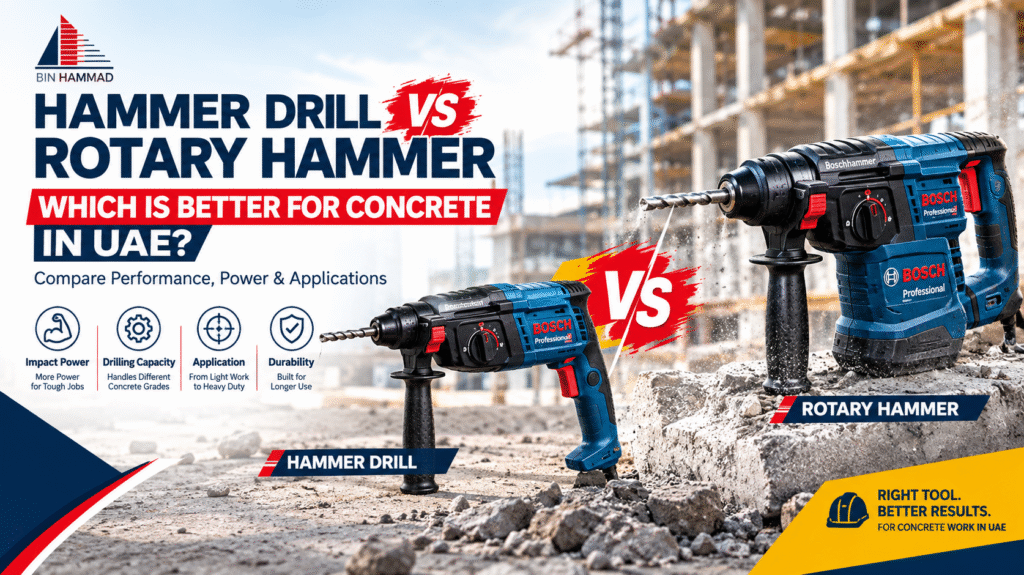
Which Is Better: Hammer Drill or Rotary Hammer?
A rotary hammer is generally better for regular concrete drilling, larger holes, hard concrete, and chiselling, while a hammer drill is better for occasional small holes in brick, block, masonry, and lighter concrete. The right choice depends on the material, hole diameter, drilling depth, number of holes, required impact power, and type of construction work.
For example, a contractor installing a few small wall anchors may find a hammer drill practical. However, a team drilling dozens of anchor holes into concrete may benefit more from a rotary hammer because it delivers stronger impact energy and requires less operator pressure.
Understanding the difference between a hammer drill vs rotary hammer helps contractors, electricians, plumbers, HVAC technicians, maintenance teams, and other construction professionals choose the right tool for the job.
For UAE buyers, Bin Hammad Trading Enterprises LLC provides power tools and industrial equipment for construction, maintenance, and professional applications. Buyers can explore the Bin Hammad Trading Enterprises LLC website for power tools and related equipment.
Hammer Drill vs Rotary Hammer at a Glance
| Feature | Hammer Drill | Rotary Hammer |
| Main purpose | General drilling and light masonry | Concrete and heavy masonry drilling |
| Impact mechanism | Mechanical hammering action | Piston-based impact mechanism |
| Impact energy | Lower | Higher |
| Small masonry holes | Excellent | Suitable |
| Regular concrete drilling | Limited compared with rotary hammer | Excellent |
| Large holes | Less suitable | More suitable |
| Chiselling | Usually not available | Available on many models |
| Bit system | Standard chuck and compatible bits | SDS-Plus or SDS-Max on many models |
| Wood and metal | Very versatile | Less suitable for regular work |
| Operator effort | Usually higher for concrete | Usually lower for concrete |
| Portability | Generally lighter | Generally heavier |
| Best for | Light construction and maintenance | Professional concrete work |
Quick Verdict
Choose a hammer drill when you need a versatile tool for occasional masonry drilling and smaller holes.
Choose a rotary hammer when you regularly drill concrete, need larger holes, work with hard masonry, or require chiselling.
What Is a Hammer Drill?
A hammer drill is a power drill that combines normal rotary drilling with a rapid hammering action.
The hammering function helps the bit break through masonry while the bit rotates. Workers can usually switch the hammer function off when they need to drill materials such as wood or metal with the appropriate bit.
This makes a hammer drill a versatile option for general construction and maintenance.
How Does a Hammer Drill Work?
A hammer drill commonly uses a mechanical cam or clutch mechanism.
As the motor rotates, the internal components create a rapid back-and-forth movement. This produces many relatively light impacts against the drill bit.
The operator usually applies some forward pressure to keep the hammering action working effectively.
This mechanism works well for lighter masonry applications, but it does not provide the same impact energy as a rotary hammer.
What Is a Hammer Drill Used For?
Workers commonly use hammer drills for:
- Small masonry holes
- Brick drilling
- Concrete block drilling
- Wall plug installation
- Light-duty anchors
- Bracket installation
- Electrical fittings
- Plumbing supports
- Shelving installation
- General maintenance
- Occasional concrete drilling
A hammer drill can therefore work well when a project involves different materials and only occasional masonry drilling.
Advantages of a Hammer Drill
Greater General-Purpose Versatility
A hammer drill can often switch between standard drilling and hammer drilling. This makes it useful when workers move between wood, metal, masonry, and other suitable materials.
Compact Handling
Many hammer drills have a relatively compact design compared with heavy-duty rotary hammers.
Suitable for Occasional Concrete Work
If a worker needs to make a few small holes in concrete or masonry, a hammer drill may provide sufficient performance.
Useful for Maintenance Work
Maintenance teams often need one tool that can handle several light applications. A hammer drill can provide this flexibility when the workload does not justify a heavier rotary hammer.
What Is a Rotary Hammer?
A rotary hammer is a heavy-duty power tool designed primarily for drilling and chiselling concrete, masonry, and other hard materials.
Instead of relying on a light mechanical tapping action, many rotary hammers use a piston-based impact mechanism that delivers much stronger blows to the bit.
This makes them particularly useful for professional construction work.
How Does a Rotary Hammer Work?
A rotary hammer commonly uses an electro-pneumatic mechanism.
The motor drives an internal piston. The piston compresses air, which transfers energy to a striker. The striker then delivers a powerful impact through the bit.
This mechanism allows the tool to break hard materials more efficiently than a typical hammer drill.
Because the impact mechanism does more of the material-breaking work, the operator generally does not need to push the tool as aggressively.
What Is a Rotary Hammer Used For?
Construction professionals commonly use rotary hammers for:
- Concrete drilling
- Hard masonry drilling
- Anchor installation
- MEP installation
- HVAC supports
- Electrical conduit installation
- Plumbing penetrations
- Large concrete holes
- Tile removal
- Chiselling
- Light demolition
- Concrete repair work
Many rotary hammers also provide a hammer-only mode, which allows workers to use suitable chisels for tile removal and other applications.
Hammer Drill vs Rotary Hammer: How Are They Different?
The main difference between a hammer drill and rotary hammer comes from the impact mechanism and the amount of energy transferred to the bit.
Hammer Drill Impact Mechanism
A hammer drill produces a rapid series of relatively light impacts.
The bit rotates while the mechanism creates a tapping action. This helps break masonry but requires more effort when the material becomes harder.
Rotary Hammer Impact Mechanism
A rotary hammer produces stronger individual impacts through its piston-based mechanism.
This allows the tool to break concrete and hard masonry more effectively.
Therefore, contractors who regularly drill concrete generally benefit from a rotary hammer.
Impact Energy vs BPM: Which Matters More?
When comparing power tools, buyers sometimes focus heavily on BPM, or blows per minute.
However, BPM alone does not determine drilling performance.
What Does BPM Mean?
BPM means blows per minute. It describes how many impact cycles a tool produces during operation.
A higher BPM does not automatically mean that the tool delivers more drilling power.
What Is Impact Energy?
Impact energy describes the energy delivered during each impact.
A rotary hammer can deliver much stronger individual impacts than a typical hammer drill. This difference becomes particularly important when drilling hard concrete.
Therefore, buyers should compare impact energy, drilling capacity, BPM, motor performance, and manufacturer specifications together rather than choosing a tool based on BPM alone.
Hammer Drill vs Rotary Hammer for Concrete
Concrete drilling represents one of the clearest situations where the difference between these tools matters.
Use a Hammer Drill for Occasional Small Concrete Holes
A hammer drill can work for smaller and occasional holes when the concrete and tool specifications allow it.
Typical applications include:
- Small anchors
- Wall brackets
- Cable supports
- Light fixtures
- Small mounting points
However, drilling speed and operator effort can become less efficient as the material becomes harder or the number of holes increases.
Use a Rotary Hammer for Regular Concrete Drilling
A rotary hammer becomes more suitable when the job involves:
- Hard concrete
- Repeated drilling
- Larger holes
- Deeper holes
- Heavy anchors
- Concrete installations
- Chiselling
For professional construction projects, a rotary hammer can improve productivity because its stronger impact mechanism breaks the material more efficiently.
Which Tool Should You Use for Different Materials?
The material you need to drill should influence your choice.
Brick
A hammer drill can usually handle many brick-drilling applications when workers use the correct masonry bit.
Concrete Block
A hammer drill can work for smaller holes in concrete block, while a rotary hammer becomes more useful for repeated or larger drilling.
Standard Concrete
For occasional small holes, a hammer drill may be sufficient. For regular drilling, a rotary hammer provides a more suitable solution.
Hard Concrete
A rotary hammer generally provides better performance because it delivers stronger impact energy.
Reinforced Concrete
Reinforced concrete requires additional consideration because workers may encounter steel reinforcement.
A rotary hammer may be suitable for many applications, but workers should assess the hole size, depth, reinforcement, tool capacity, and project requirements before drilling.
Stone and Hard Masonry
Hard masonry and stone can require stronger impact performance. A suitable rotary hammer may provide better results than a conventional hammer drill, depending on the material and tool specifications.
How Many Concrete Holes Are You Drilling?
The number of holes can be just as important as the hole size.
A Few Holes
If you need only a few small holes for anchors or fittings, a hammer drill may provide enough performance.
Dozens of Holes
When a project requires repeated concrete drilling, a rotary hammer becomes more attractive because its stronger impact action can improve productivity.
Hundreds of Holes
Large construction and MEP projects can involve hundreds of anchor holes.
For this type of workload, contractors should generally consider professional rotary hammer equipment with suitable impact energy, drilling capacity, bit compatibility, and ergonomics.
Which Tool Should You Use for Different Hole Sizes?
There is no single hole diameter that determines when you must switch from one tool to another because tool capacity varies by manufacturer and model.
However, the general principle remains simple.
Small Holes
Small anchor and fixing holes may suit a hammer drill when the material and workload remain within the tool’s specifications.
Medium Holes
As hole diameter and drilling depth increase, a rotary hammer becomes more practical because it can deliver stronger impact energy.
Large Holes
Large holes may require a heavy-duty rotary hammer or specialist equipment such as a core drill, depending on the diameter, depth, material, and application.
Always check the manufacturer’s stated drilling capacity before selecting the tool.
SDS-Plus vs SDS-Max
Rotary hammers commonly use SDS-Plus or SDS-Max bit systems.
What Is SDS-Plus?
SDS-Plus is widely used on compact and medium-duty rotary hammers.
It suits applications such as:
- Anchor drilling
- Electrical installation
- Plumbing
- MEP work
- Concrete drilling
- Masonry drilling
- Tile removal
- Light chiselling
Its relatively compact design makes SDS-Plus tools practical for many everyday construction applications.
What Is SDS-Max?
SDS-Max supports heavier-duty rotary hammers and larger accessories.
Workers can use SDS-Max equipment for:
- Larger concrete holes
- Heavy chiselling
- Hard masonry
- Intensive construction work
- Demolition applications
- Larger drilling tasks
The right system depends on the tool, accessory, hole size, material, and workload.
What Are the Operating Modes of a Rotary Hammer?
One advantage of many rotary hammers is their multiple operating modes.
Rotary-Only Mode
This mode allows the tool to rotate without the hammering function for compatible drilling applications.
Rotary Hammer Mode
This combines rotation and impact.
Workers commonly use this mode for concrete and masonry drilling.
Hammer-Only Mode
This mode disables rotation and allows the tool to operate with a suitable chisel.
Workers can use it for applications such as:
- Tile removal
- Chiselling
- Removing mortar
- Light demolition
- Surface preparation
Not every rotary hammer provides the same modes, so buyers should check the manufacturer’s specifications.
Hammer Drill vs Rotary Hammer: Versatility
A hammer drill generally provides greater versatility for general drilling.
Hammer Drill Versatility
A suitable hammer drill can support:
- Wood drilling
- Metal drilling
- Masonry drilling
- Concrete drilling
- Fastening applications
Workers can switch between operating modes and accessories according to the application.
Rotary Hammer Versatility
A rotary hammer focuses more heavily on concrete and masonry.
However, multiple operating modes can make it useful for drilling and chiselling.
Therefore, a hammer drill may be the better choice for general maintenance, while a rotary hammer may be the better choice for professional concrete work.
Corded vs Cordless Rotary Hammers
Power source also matters when selecting construction equipment.
Corded Rotary Hammers
Corded tools can work well for long-duration applications where a reliable electrical supply is available.
They can suit:
- Workshops
- Continuous site work
- Large construction areas
- Heavy-duty applications
However, workers must manage the power cable safely.
Cordless Rotary Hammers
Cordless tools provide greater mobility.
They can work well when:
- Workers move between locations
- Power outlets are limited
- Teams need quick setup
- The job requires greater freedom of movement
Buyers should consider battery capacity, runtime, charging time, battery availability, and tool weight before selecting a cordless model.
Which Tool Is Better for UAE Construction Projects?
The hammer drill vs rotary hammer decision can vary across UAE construction projects.
Residential Maintenance
For occasional wall mounting, small anchors, and light masonry drilling, a hammer drill can provide useful versatility.
Commercial Fit-Outs
Commercial fit-out work can involve repeated drilling for brackets, supports, cable trays, partitions, and equipment.
A rotary hammer may become more practical when workers drill concrete repeatedly.
Electrical Installation
Electricians often need to install conduit supports, cable trays, brackets, and other fixtures.
The right tool depends on the material, hole size, and number of fixing points.
HVAC Installation
HVAC installation can involve repeated anchor drilling for supports and equipment.
A rotary hammer can provide an advantage when workers drill many holes into concrete.
Plumbing Work
Plumbers may use power tools to create holes and install supports.
The correct choice depends on the material, hole size, and installation requirements.
Industrial Projects
Industrial construction can involve hard concrete, large anchors, repeated drilling, and demanding work conditions.
Professional rotary hammers may provide more suitable performance for these applications.
For UAE contractors and industrial buyers, the best choice should therefore depend on the actual workload rather than simply the advertised motor power or brand name.
How to Choose Between a Hammer Drill and Rotary Hammer
Before buying either tool, consider the following factors.
Consider the Material
Identify whether you will drill brick, block, concrete, reinforced concrete, stone, or another material.
Consider Hole Diameter
Determine the typical hole size required for your project.
Consider Hole Depth
Deep holes can require greater tool capacity and suitable accessories.
Consider the Number of Holes
Occasional drilling and continuous drilling place different demands on the equipment.
Consider Impact Energy
Compare impact energy when evaluating rotary hammers.
Consider BPM
Use BPM as one specification rather than the only measure of performance.
Consider the Bit System
Check whether the tool uses a standard chuck, SDS-Plus, SDS-Max, or another system.
Consider Tool Weight
A heavier tool may provide greater performance but can also increase operator fatigue.
Consider Power Source
Choose corded or cordless equipment based on the work environment and required mobility.
Consider Accessories
Check the availability and compatibility of drill bits, chisels, dust-extraction accessories, and other required equipment.
Common Mistakes When Choosing a Hammer Drill or Rotary Hammer
Choosing a Hammer Drill for Heavy Concrete Work
A hammer drill may struggle with repeated drilling in hard concrete.
If the application requires substantial impact energy, consider a suitable rotary hammer.
Choosing a Rotary Hammer for Every Small Job
A rotary hammer can be unnecessarily heavy for occasional small masonry holes.
A hammer drill may provide better portability and general-purpose versatility.
Comparing Only Motor Power
A higher wattage does not automatically mean better drilling performance.
Consider impact energy, mechanism, drilling capacity, speed, ergonomics, and application.
Comparing Only BPM
A high BPM does not automatically indicate high impact performance.
Look at the complete specification.
Ignoring Bit Compatibility
Always confirm that the accessory matches the tool.
For rotary hammers, check whether you need SDS-Plus or SDS-Max.
Using the Wrong Bit
Use bits designed for the material and tool.
A suitable concrete bit can improve drilling performance and help maintain better control.
Applying Excessive Pressure
Allow the tool’s impact mechanism to do the work.
Excessive force can increase fatigue and may reduce effective performance.
Safety Tips for Hammer Drills and Rotary Hammers
Power tools can create hazards when workers use them incorrectly.
Inspect the Tool Before Use
Check the tool, cable, battery, chuck, bit, auxiliary handle, guards, and other relevant components before operation.
Do not use damaged equipment.
Wear Suitable PPE
Depending on the application, workers may need:
- Safety glasses
- Hearing protection
- Safety footwear
- Suitable gloves
- Respiratory protection
Follow the requirements of the specific workplace and task.
Check for Hidden Services
Before drilling into walls, floors, or slabs, identify potential electrical cables, water pipes, gas lines, and other concealed services.
Control Concrete Dust
Concrete drilling can produce fine dust.
Use suitable dust-control and extraction methods and follow applicable workplace requirements.
Keep Good Tool Control
Maintain a stable stance and use the auxiliary handle where the manufacturer provides one.
Avoid awkward positions that reduce control.
Use the Correct Accessory
Check the accessory’s compatibility, size, condition, and speed or operating requirements before use.
How Bin Hammad Trading Enterprises LLC Can Help With Power Tool Requirements
Selecting between a hammer drill and rotary hammer becomes easier when buyers understand the application and have access to suitable power-tool options.
Bin Hammad Trading Enterprises LLC supplies power tools, hand tools, construction equipment, hardware, safety products, welding equipment, building materials, and other industrial supplies for professional and construction requirements in the UAE.
The company focuses on supplying equipment for contractors, builders, engineers, maintenance teams, procurement professionals, and industrial buyers.
If you are comparing different equipment options, you can explore the Bin Hammad Trading Enterprises LLC website for its power-tool and industrial product range.
You can also learn more about selecting a reliable power tools supplier in the UAE when evaluating suppliers for professional requirements.
For buyers looking specifically for information about power tools in Dubai, Bin Hammad provides additional information about power-tool applications and purchasing considerations.
If you are researching Bosch equipment, the Bosch power tools guide can also help you understand the brand’s power-tool range and applications.
Conclusion
The choice between a hammer drill vs rotary hammer depends mainly on the work you need to complete.
A hammer drill works well for occasional small masonry holes, light concrete drilling, maintenance tasks, and applications where you also need to drill wood or metal.
A rotary hammer is generally the better choice for regular concrete drilling, larger holes, hard masonry, repeated anchor installation, and chiselling.
For UAE construction professionals, the best approach is to compare the material, hole size, hole depth, number of holes, impact energy, bit system, operating modes, power source, and tool weight before purchasing.
Do not automatically choose the most powerful machine. Instead, choose a tool that matches the actual workload.
For contractors, builders, MEP professionals, maintenance teams, and industrial buyers, Bin Hammad Trading Enterprises LLC provides a practical source for power tools and related construction equipment in the UAE.
FAQs
Q1. Which is better for concrete, a hammer drill or rotary hammer?
Ans. A rotary hammer is generally better for regular concrete drilling because it provides stronger impact energy. A hammer drill can handle smaller and occasional concrete holes when the application falls within its specifications.
Q2. Can a hammer drill drill concrete?
Ans. Yes. A hammer drill can drill suitable concrete with the correct masonry or concrete bit. However, it may become less efficient for hard concrete, larger holes, or repeated drilling.
Q3. When should I use a rotary hammer?
Ans. Use a rotary hammer when you regularly drill concrete, need larger or deeper holes, work with hard masonry, or require chiselling capability.
Q4. What is the main difference between a hammer drill and rotary hammer?
Ans. The main difference is the impact mechanism. A hammer drill uses a lighter mechanical hammering action, while a rotary hammer commonly uses a piston-based mechanism that delivers stronger impacts.
Q5. Is SDS-Plus better than SDS-Max?
Ans. Neither system is universally better. SDS-Plus suits many light and medium-duty applications, while SDS-Max supports heavier rotary hammers and demanding drilling or chiselling work.
Q6. Can I use a rotary hammer for chiselling?
Ans. Many rotary hammers provide a hammer-only mode that allows workers to use compatible chisels for applications such as tile removal and light demolition.
Q7. Is a hammer drill good for brick?
Ans. Yes. A hammer drill can work well for many brick-drilling applications when workers use the correct masonry bit and suitable operating mode.
Q8. Does a rotary hammer require less effort?
Ans. A rotary hammer’s stronger impact mechanism generally reduces the amount of pushing force needed compared with a conventional hammer drill when drilling hard materials.
Q9. Is a cordless rotary hammer suitable for construction?
Ans. Yes, depending on the model, application, battery capacity, and workload. Cordless rotary hammers provide greater mobility, while corded models can suit long-duration work where continuous electrical power is available.
Q10. What should I check before buying a rotary hammer in UAE?
Ans. Check the material, hole diameter, hole depth, drilling frequency, impact energy, BPM, SDS system, operating modes, tool weight, power source, accessories, and manufacturer specifications.
