
What cable tie sizes do you need? The right cable tie size depends on the length, width, bundle diameter, tensile strength, material, and installation environment. For example, a 200 × 4.8 mm cable tie is approximately 200 mm long and 4.8 mm wide. Bin Hammad Trading Enterprises supplies cable ties and other electrical, construction, hardware, and industrial products for contractors and businesses across the UAE.
Choosing the right cable tie helps you secure cables without using a tie that is too short, too weak, or unsuitable for the environment. This guide explains cable tie sizes, dimensions, materials, strength, applications, and selection tips in simple language.
Cable Tie Size Chart
The following chart provides a practical reference for common cable tie sizes. Exact bundle capacity and tensile strength can vary by manufacturer, so always check the product specification before purchase.
| Cable Tie Size | Typical Use | General Category |
| 100 × 2.5 mm | Small wires and electronics | Light duty |
| 150 × 3.6 mm | Control wiring and small bundles | Light/medium duty |
| 200 × 3.6 mm | Electrical panels and equipment | Medium duty |
| 200 × 4.8 mm | General cable management | Medium duty |
| 250 × 4.8 mm | Construction and electrical work | Medium duty |
| 300 × 4.8 mm | Larger cable bundles | Standard duty |
| 300 × 7.6 mm | Heavy cable management | Heavy duty |
| 400 × 7.6 mm | Industrial applications | Heavy duty |
| 500 mm+ | Large industrial bundles | Extra-long/heavy duty |
Use this table as a starting point rather than a universal sizing standard. Different manufacturers can assign different bundle diameters and tensile ratings to similar dimensions.
What Do Cable Tie Sizes Mean?
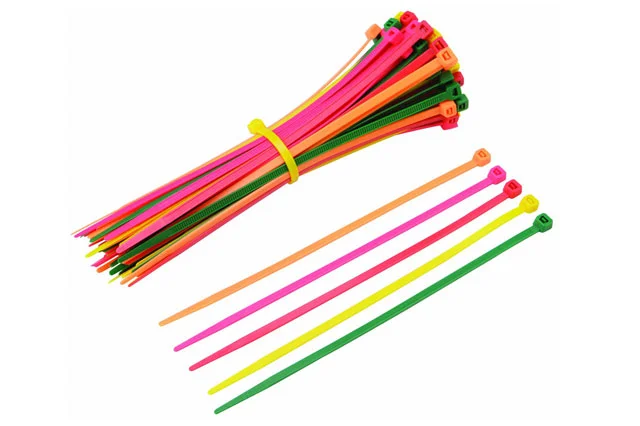
Cable tie sizes normally show length × width, measured in millimetres.
For example:
200 × 4.8 mm Cable Tie
- 200 mm indicates the approximate overall length.
- 4.8 mm indicates the strap width.
However, these two numbers do not tell you everything about a cable tie. You should also check:
- Maximum bundle diameter
- Tensile strength
- Material
- Thickness
- Temperature resistance
- UV resistance
- Chemical resistance
- Locking mechanism
For example, a 300 × 4.8 mm tie generally provides more wrapping length than a 200 × 4.8 mm tie. However, the exact usable bundle diameter depends on the manufacturer’s design and specifications.
What Is the Standard Cable Tie Size?
There is no single standard cable tie size for every application.
Manufacturers produce cable ties in many lengths, including approximately:
- 100 mm
- 150 mm
- 200 mm
- 250 mm
- 300 mm
- 400 mm
- 500 mm
- 600 mm and longer
They also produce different widths and tensile strengths.
Small ties suit compact wiring, while longer and wider ties suit larger bundles and demanding applications. Therefore, choose a cable tie based on the actual bundle and application instead of selecting the most common size.
How to Choose the Right Cable Tie Size
Choosing cable tie sizes becomes easier when you follow a simple process.
1. Measure the Cable Bundle
First, group the cables as you plan to install them. Then estimate or measure the bundle diameter.
The tie must have enough length to wrap around the entire bundle and pass through the locking head.
Do not select a cable tie by looking at one cable. Measure the complete bundle you need to secure.
2. Choose the Correct Length
Select a tie that provides enough length to surround the bundle and engage the locking mechanism properly.
A longer cable tie mainly gives you more wrapping capacity. It does not automatically mean that the tie has greater tensile strength.
For example, a small 100 mm tie may work for a compact wiring bundle, while a 300 mm or longer tie may work better for larger cable groups.
3. Check the Width
Width contributes to the mechanical strength of a cable tie.
Wider ties often provide higher tensile ratings, but you should always check the manufacturer’s stated tensile strength instead of judging strength from width alone.
4. Check Tensile Strength
Tensile strength shows how much pulling force a cable tie can withstand during the specified test.
If your application involves heavier bundles or greater mechanical stress, choose a tie with an appropriate tensile rating.
Remember that the published tensile strength represents a tested performance value. It does not automatically represent a safe working-load rating.
5. Select the Correct Material
Choose the material according to the installation environment.
Standard nylon works for many indoor applications. UV-resistant nylon can suit outdoor applications, while stainless steel can suit certain demanding industrial or corrosive environments.
6. Consider the Environment
Before choosing a cable tie, consider:
- Heat
- Sunlight
- UV exposure
- Moisture
- Chemicals
- Corrosion
- Indoor or outdoor installation
A cable tie designed for indoor use may not provide the performance you need outdoors.
Cable Tie Length, Width and Tensile Strength Explained
These specifications perform different roles.
Cable Tie Length
Length determines how much cable the tie can surround.
A longer tie generally accommodates a larger bundle, but the exact maximum bundle diameter depends on the product.
Cable Tie Width
Width contributes to mechanical strength.
Wider straps generally contain more material and can support higher tensile ratings, depending on the design.
Cable Tie Tensile Strength
Tensile strength indicates the pulling force a cable tie can withstand under specified testing conditions before failure.
Current cable tie guides consistently emphasize that buyers should evaluate length, width, bundle diameter, and tensile strength together rather than choosing by length alone.
Cable Tie Types and Their Applications
Standard Nylon Cable Ties
Standard nylon cable ties work well for many general indoor cable-management applications.
Professionals commonly use them for:
- Electrical panels
- Computer cables
- Equipment wiring
- Construction work
- Workshop maintenance
- General cable organization
They provide a simple and economical way to organize suitable cable bundles.
Heavy-Duty Cable Ties
Heavy-duty cable ties use wider straps and higher tensile ratings than many standard options.
They can suit:
- Large cable bundles
- Industrial wiring
- Cable trays
- Construction equipment
- HVAC installations
- Heavy-duty maintenance
Always match the tensile rating to the actual application.
UV-Resistant Cable Ties
Outdoor installations expose cable ties to sunlight and UV radiation.
UV-resistant cable ties can provide better outdoor performance than standard indoor ties when the manufacturer specifically rates them for UV exposure.
Releasable Cable Ties
Releasable cable ties allow workers to open and reuse the tie without cutting it.
They work well when teams need to:
- Add cables
- Remove cables
- Modify wiring
- Perform maintenance
- Reorganize equipment
Stainless Steel Cable Ties
Stainless steel cable ties provide a strong option for selected harsh environments.
Professionals may use them in:
- Marine applications
- Industrial installations
- High-temperature environments
- Corrosive conditions
- Heavy-duty applications
Always select the appropriate stainless-steel grade and product specification for the environment.
Are Black Cable Ties Stronger Than White Cable Ties?
Colour alone does not determine cable tie strength.
Manufacturers often use carbon black in black nylon ties to improve resistance to UV exposure. However, you should not assume that every black cable tie provides the same UV performance.
Always check the manufacturer’s specifications for:
- Material
- UV resistance
- Tensile strength
- Temperature range
- Intended application
For indoor installations, colour can also help workers identify and organize cable groups.
Can Cable Ties Be Used Outdoors?
Yes, you can use cable ties outdoors when you select a product designed for the expected conditions.
Outdoor installations can expose cable ties to:
- Sunlight
- UV radiation
- Rain
- Humidity
- Heat
- Dust
- Temperature changes
For UAE projects, high temperatures and strong sunlight make material selection particularly important.
IEC 62275:2022 specifies requirements for metallic, non-metallic, and composite cable ties and associated fixing devices used for managing or securing wiring systems in electrical installations. The standard also addresses testing related to characteristics such as mechanical performance and UV resistance.
Cable Tie Sizes for Different Applications
| Application | Recommended Category |
| Small electronic wiring | Mini/light duty |
| Computer and network cables | Small/standard |
| Electrical panels | Standard |
| Construction wiring | Standard/heavy duty |
| HVAC cable bundles | Long/standard or heavy duty |
| Large cable trays | Long/heavy duty |
| Outdoor installations | UV-resistant |
| Harsh industrial environments | Specialized or stainless steel |
These recommendations provide general guidance. Always verify the manufacturer’s bundle diameter, tensile strength, temperature rating, and environmental specifications.
Cable Tie Sizes for Electrical Wiring
Electricians use cable ties to organize and secure suitable wire and cable bundles.
When selecting cable tie sizes for electrical work, consider:
- Cable bundle diameter
- Cable weight
- Tie length
- Tie width
- Tensile strength
- Temperature
- UV exposure
- Installation location
Avoid over-tightening cable ties around electrical cables because excessive pressure can damage cable insulation.
For broader construction and electrical requirements, you can also explore Bin Hammad’s guide to Construction and Building Materials.
Cable Tie Sizes for Construction and HVAC
Construction projects use cable ties for cable organization, equipment wiring, installation work, temporary arrangements, and maintenance.
HVAC teams may require longer or stronger ties when they organize larger cable bundles around equipment.
The correct size depends on the bundle diameter, cable weight, installation environment, and required strength.
For wider construction procurement requirements, explore Construction Materials Suppliers in UAE.
When HVAC or electrical work requires other tools and equipment, Bin Hammad also provides information about Power Tools Suppliers in UAE.
How to Install Cable Ties Correctly
Follow these steps for a clean and secure installation.
Step 1: Group the Cables
Arrange the cables into the required bundle.
Step 2: Select the Correct Tie
Check the length, width, tensile strength, material, and environmental rating.
Step 3: Wrap the Tie
Pass the tail around the cable bundle and through the locking head.
Step 4: Tighten Carefully
Apply enough tension to secure the cables without crushing or damaging them.
Step 5: Check the Lock
Make sure the locking mechanism engages correctly.
Step 6: Remove the Excess
Cut the remaining tail cleanly with an appropriate cutter.
Avoid leaving sharp edges that could injure workers.
For repetitive installations, a suitable cable-tie tensioning tool can help workers achieve more consistent results.
Cable Tie Standards and Specifications
Professional buyers should consider recognized standards and manufacturer specifications when selecting cable ties for demanding installations.
IEC 62275:2022 covers cable ties and associated fixing devices used to manage or secure wiring systems in electrical installations. It applies to metallic, non-metallic, and composite cable ties and includes requirements related to testing and classification.
Before purchasing cable ties for a project, check:
- Size
- Material
- Tensile strength
- Bundle diameter
- Temperature rating
- UV resistance
- Corrosion resistance
- Applicable standards
- Manufacturer instructions
This approach helps procurement teams select products according to project requirements instead of choosing only by price.
Why Choose Bin Hammad Trading Enterprises?
Bin Hammad Trading Enterprises supplies cable ties and a wide range of construction, electrical, hardware, safety, and industrial products for professional customers across the UAE.
When you know the required length, width, strength, and material, you can explore the Cable Tie product from Bin Hammad for your cable-management requirements.
Bin Hammad also supports broader procurement needs, including:
- Construction materials
- Electrical products
- Fasteners
- Power tools
- Hand tools
- Safety equipment
- Welding products
- Industrial consumables
- Hardware
This broad product range helps contractors and businesses manage multiple project requirements through one supplier.
Conclusion
Choosing the right cable tie size requires more than checking the length printed on the package. You should consider the bundle diameter, length, width, tensile strength, material, temperature, UV exposure, and installation environment.
Small cable ties work well for compact wiring, while longer and wider options can secure larger bundles. UV-resistant products can suit outdoor applications, while stainless steel options can support selected harsh environments.
Before purchasing, measure your cable bundle, select an appropriate length, check the tensile strength, and choose a material that matches the environment.
For contractors, electricians, maintenance teams, and businesses in the UAE, Bin Hammad Trading Enterprises provides cable ties alongside construction, electrical, hardware, safety, and industrial products.
FAQs
Q1. What are the most common cable tie sizes?
Ans. Common lengths include 100 mm, 150 mm, 200 mm, 250 mm, 300 mm, 400 mm, 500 mm, and longer options. Width and tensile strength vary by product.
Q2. What does 200 × 4.8 mm mean?
Ans. A 200 × 4.8 mm cable tie has an approximate overall length of 200 mm and a strap width of 4.8 mm.
Q3. How do I know what cable tie size I need?
Ans. Measure the cable bundle first. Then select a tie with enough length to wrap around it and check its tensile strength, width, material, and environmental rating.
Q4. Does cable tie width affect strength?
Ans. Yes. Width contributes to the mechanical strength of a cable tie. However, always verify the manufacturer’s tensile-strength rating.
Q5. Are black cable ties UV resistant?
Ans. Some black cable ties provide UV resistance, but colour alone does not guarantee it. Check the manufacturer’s specifications.
Q6. Can I use cable ties outdoors?
Ans. Yes. Choose a cable tie specifically rated for the outdoor conditions it will face, including UV exposure, heat, moisture, and temperature changes.
Q7. What cable tie size works for electrical wiring?
Ans. Small and standard cable ties work for many electrical wiring applications. Larger bundles may require longer or wider ties. Always match the product to the bundle and installation requirements.
Q8. What is cable tie tensile strength?
Ans. Tensile strength indicates the pulling force that a cable tie can withstand during specified testing before failure.
Q9. Can I reuse standard cable ties?
Ans. Most standard locking cable ties require cutting for removal. Choose releasable cable ties when you expect to modify or reorganize the cable bundle.
Q10. Where can I buy cable ties in the UAE?
Ans. You can source cable ties and other construction, electrical, hardware, and industrial products from Bin Hammad Trading Enterprises for professional requirements across the UAE.
