
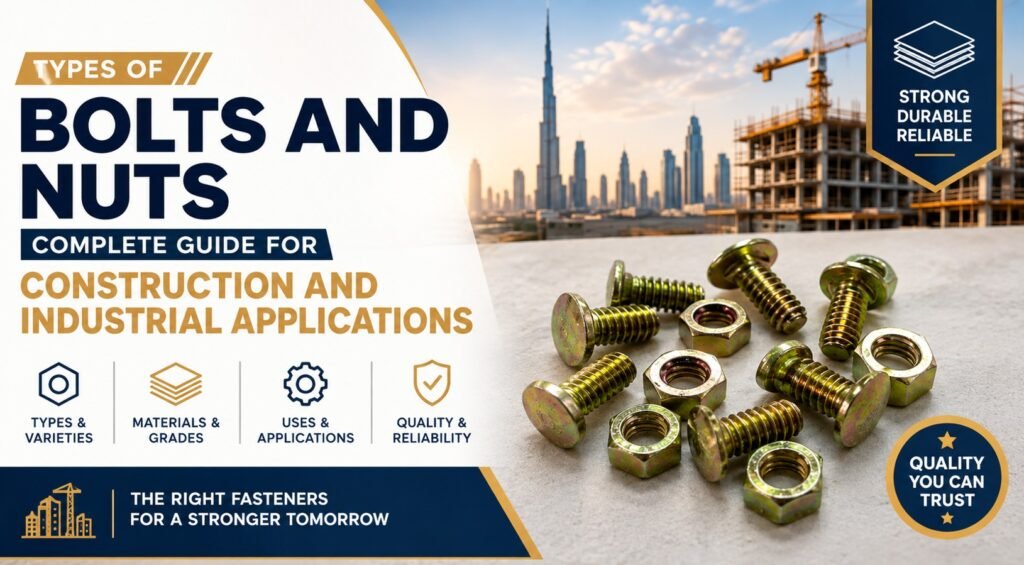
What Are the Different Types of Bolts and Nuts?
The main types of bolts and nuts include hex bolts and nuts, carriage bolts, flange bolts, U-bolts, eye bolts, anchor bolts, wing nuts, lock nuts, flange nuts, cap nuts, and formwork nuts. Each type has a different design that helps it perform a specific fastening job.
Bolts and nuts create strong, removable connections between two or more components. Construction teams, engineers, fabricators, maintenance professionals, and industrial workers use them across structural, mechanical, automotive, plumbing, and general hardware applications.
Choosing the correct bolt and nut combination matters because the wrong fastener can affect strength, stability, installation time, and service life.
For UAE construction and industrial projects, Bin Hammad Trading Enterprises LLC supplies fasteners, construction materials, hardware, tools, and industrial products for a wide range of applications.
What Are Bolts and Nuts?
A bolt is a threaded fastener that normally passes through aligned holes in two or more components. A nut threads onto the bolt and applies clamping force to hold those components together.
Together, they create a mechanical fastening system.
A typical bolted connection includes:
- Bolt
- Nut
- Washer
- Connected materials
The bolt provides the threaded shaft, while the nut creates the clamping force.
Workers can remove and replace bolted connections without permanently damaging the connected components. This makes bolts and nuts particularly useful for construction, machinery, maintenance, and industrial applications.
Why Do Bolts and Nuts Matter in Construction?
Construction projects require reliable connections between different materials and structural components.
Workers use bolts and nuts to connect:
- Steel structures
- Metal frames
- Brackets
- Machinery
- Scaffolding components
- Formwork
- Equipment supports
- Industrial assemblies
- Structural components
- Pipe supports
- Mechanical equipment
A properly selected fastener must handle the expected load and environmental conditions.
For example, a fastener used outdoors in a humid environment may require better corrosion resistance than one installed inside a dry building.
Therefore, you should consider more than the bolt’s size.
You should also check its material, grade, thread, coating, strength, and application.
Main Types of Bolts
Different bolt designs solve different fastening problems.
1. Hex Bolts
Hex bolts have a six-sided head that allows workers to tighten them using a wrench or socket.
They represent one of the most common bolt types used in construction and industrial work.
Workers use hex bolts for:
- Steel structures
- Machinery
- Equipment
- Frames
- General construction
- Maintenance
- Fabrication
You can find hex bolts in different sizes, thread configurations, materials, grades, and finishes.
For general fastening applications, explore Bin Hammad’s Hex Bolt Nut product.
When selecting a hex bolt, check the diameter, length, thread specification, material, and strength grade.
2. Carriage Bolts
Carriage bolts feature a rounded or domed head and a square section beneath the head.
The square section helps prevent the bolt from rotating when the nut is tightened.
Workers commonly use carriage bolts for:
- Timber connections
- Metal-to-wood connections
- Fencing
- Furniture
- General construction
- Outdoor structures
The smooth rounded head also provides a cleaner appearance than many standard hex-head bolts.
3. Flange Bolts
Flange bolts include an integrated flange beneath the head.
The flange spreads the clamping load across a larger area.
This design can reduce the need for a separate washer in certain applications.
Workers use flange bolts in:
- Machinery
- Automotive assemblies
- Structural applications
- Industrial equipment
- Fabrication
Always follow the manufacturer’s requirements when determining whether you need a washer with a flange bolt.
4. U-Bolts
U-bolts have a U-shaped body with threaded ends.
Workers commonly use them to secure round components such as:
- Pipes
- Tubes
- Cables
- Vehicle components
- Mechanical assemblies
The U-shape allows the fastener to wrap around the component while nuts secure it from the opposite side.
5. Eye Bolts
Eye bolts feature a loop or eye at one end.
Workers use them for applications involving attachment points, rigging, lifting arrangements, or securing components.
However, you should never assume that every eye bolt is suitable for lifting.
If an application involves lifting or suspended loads, use a correctly rated lifting component and follow the applicable manufacturer’s instructions and safety requirements.
6. Anchor Bolts
Anchor bolts secure structural components to concrete or masonry.
Workers use them for:
- Steel columns
- Base plates
- Machinery
- Equipment
- Structural frames
- Signage
- Supports
Anchor bolt systems vary considerably, so you should select them according to the substrate, load, embedment depth, installation method, and applicable engineering requirements.
7. Stud Bolts
A stud bolt generally consists of a threaded rod with threads at both ends or along its length, depending on the design.
Workers use stud bolts in:
- Flanged connections
- Industrial equipment
- Pressure-related assemblies
- Piping systems
- Mechanical applications
Stud bolts can make certain assemblies easier to install and maintain.
8. Socket Head Cap Screws
Socket head cap screws have a cylindrical head with an internal hexagonal drive.
Workers tighten them using an Allen key or hex socket.
They work well when the design requires:
- Compact installation
- High clamping force
- A clean appearance
- Limited access around the fastener head
They appear frequently in machinery, equipment, fabrication, and engineering applications.
Main Types of Nuts
A bolt needs a suitable mating component to create a secure connection.
Nuts come in many designs.
1. Hex Nuts
Hex nuts have six flat sides and work with standard hex bolts.
They represent one of the most common nut types.
Workers use them for:
- Construction
- Machinery
- Fabrication
- Equipment installation
- General maintenance
- Structural applications
You can pair a hex nut with a compatible hex bolt to create a conventional bolted connection.
2. Lock Nuts
Lock nuts help resist loosening caused by vibration or movement.
Different lock nut designs use different mechanisms to maintain the connection.
Common examples include:
- Nylon insert lock nuts
- All-metal lock nuts
- Prevailing torque nuts
The correct type depends on temperature, vibration, load, and application.
3. Flange Nuts
Flange nuts include a flange beneath the nut.
The flange distributes the clamping force over a larger surface area.
Workers commonly use them in:
- Automotive applications
- Machinery
- Industrial equipment
- Fabrication
- Structural assemblies
4. Wing Nuts
Wing nuts have extended wings that allow workers to tighten and loosen them by hand.
They work well where workers need frequent tool-free adjustment.
Common uses include:
- Temporary fixtures
- Covers
- Equipment
- Light-duty assemblies
- Maintenance applications
However, wing nuts generally do not replace high-strength nuts for heavy structural connections.
5. Cap Nuts
Cap nuts have a closed top that covers the exposed end of the bolt.
They can provide:
- A finished appearance
- Thread protection
- Reduced exposure of sharp bolt ends
Workers commonly use them in furniture, machinery, decorative assemblies, and general hardware.
6. Square Nuts
Square nuts have four sides rather than six.
Their shape can provide additional surface contact in certain applications and can help resist rotation when fitted into suitable recesses.
They can appear in:
- Machinery
- Timber structures
- Vintage or specialized assemblies
- General fabrication
7. T-Nuts
T-nuts provide threaded attachment points in materials such as wood and certain panels.
They can help create removable threaded connections where a standard nut would not work conveniently.
Workers commonly use them in:
- Furniture
- Woodworking
- Panels
- Fixtures
- Custom assemblies
8. Formwork Nuts
Formwork nuts serve specific applications in concrete formwork systems.
Construction teams use them with compatible formwork components to hold and secure formwork assemblies during concrete placement.
Formwork connections need to withstand the forces created during concrete pouring and vibration.
You can explore Bin Hammad’s Formwork Nut for this specialized construction application.
Always use formwork fasteners according to the formwork system’s design and load requirements.
Bolt and Nut Sizes Explained
Fastener size affects compatibility and performance.
Common measurements include:
- Diameter
- Length
- Thread pitch
- Thread type
- Head size
- Nut size
For example, an M10 bolt has a nominal thread diameter of approximately 10 mm.
However, diameter alone does not provide enough information.
You should also consider:
- Bolt length
- Thread pitch
- Strength grade
- Material
- Coating
- Nut compatibility
Always match the nut to the bolt’s thread specification.
Do not force a mismatched nut onto a bolt.
Metric vs Imperial Bolts and Nuts
Bolts and nuts generally use either metric or imperial measurement systems.
Metric Fasteners
Metric fasteners use millimetres for diameter and commonly use thread pitch in millimetres.
Examples include:
- M6
- M8
- M10
- M12
- M16
- M20
Imperial Fasteners
Imperial fasteners use inch-based measurements.
They may use thread specifications such as:
- UNC
- UNF
- BSW
- BSF
You should not mix metric and imperial fasteners simply because their dimensions appear similar.
Always confirm the exact thread specification before installation.
Understanding Bolt Strength Grades
Bolt strength matters when the connection must carry significant loads.
Manufacturers use strength classes or grades to identify mechanical properties.
For example, metric bolts may carry markings such as:
- 8.8
- 10.9
- 12.9
These markings provide information about the bolt’s mechanical strength.
Higher-strength bolts can handle greater loads, but you should never select them solely because they have a higher number.
The entire connection must match the engineering requirements.
Consider:
- Bolt grade
- Nut grade
- Washer specification
- Joint design
- Load
- Torque
- Material
- Environmental conditions
For structural applications, always follow the applicable engineering design and fastener specification.
Bolt Materials and Finishes
Manufacturers produce bolts and nuts from different materials.
Carbon Steel
Carbon steel fasteners provide a common solution for construction and industrial applications.
They offer good strength and can work well when the environment does not require high corrosion resistance.
Stainless Steel
Stainless steel provides strong corrosion resistance.
It can work well for:
- Outdoor applications
- Marine environments
- Food-related equipment
- Humid environments
- Architectural applications
However, stainless steel does not automatically outperform every other material in every mechanical application.
Select the material based on the required strength and environment.
Galvanized Fasteners
Galvanized coatings help protect steel fasteners against corrosion.
They can provide a practical solution for outdoor and construction applications where corrosion resistance matters.
The coating type and thickness affect performance, so check the product specification.
How to Choose the Right Bolt and Nut
Selecting the correct fastener requires more than matching the diameter.
Follow these steps.
Step 1: Identify the Application
Determine what you need to connect.
Is it:
- Steel
- Timber
- Concrete
- Machinery
- Pipework
- Formwork
- Equipment
- General hardware?
The application determines the fastener design.
Step 2: Determine the Load
Consider whether the connection will experience:
- Tension
- Shear
- Compression
- Vibration
- Impact
- Repeated loading
For structural connections, engineers should determine the required fastener capacity.
Step 3: Choose the Bolt Type
Select a design that suits the application.
For example:
- Hex bolts for general fastening
- U-bolts for pipes
- Anchor bolts for concrete connections
- Carriage bolts for selected timber applications
- Formwork nuts for compatible formwork systems
Step 4: Select the Correct Diameter and Length
Choose a size that provides sufficient engagement without creating unnecessary excess thread.
The correct length depends on the thickness of the connected materials, washer requirements, and nut engagement.
Step 5: Select the Material and Grade
Consider:
- Required strength
- Corrosion exposure
- Temperature
- Chemical exposure
- Indoor or outdoor installation
This helps you choose between carbon steel, stainless steel, galvanized, or another suitable material.
Step 6: Match the Nut
The nut must match the bolt’s:
- Thread diameter
- Thread pitch
- Thread standard
- Strength requirements
Never assume that a nut will fit simply because its diameter appears similar.
Bolts and Nuts for Construction in the UAE
UAE construction projects use fasteners across many areas.
Contractors may use them for:
- Steel structures
- Formwork
- Equipment installation
- Mechanical systems
- Pipe supports
- Fabrication
- Building maintenance
- Industrial facilities
- General construction
Environmental conditions also influence fastener selection.
Outdoor projects may expose fasteners to:
- Humidity
- Rain
- Dust
- Heat
- Coastal salt
- Chemical environments
Therefore, buyers should consider corrosion protection and material compatibility.
For a wider range of construction-related materials, you can explore Bin Hammad’s structural and building materials category.
Common Mistakes When Buying Bolts and Nuts
1. Choosing the Wrong Thread
A metric nut will not correctly match an imperial bolt, even if the dimensions look similar.
Always confirm the thread specification.
2. Ignoring Strength Grade
A fastener’s appearance does not tell you its mechanical strength.
Check the manufacturer’s grade or class marking.
3. Mixing Different Materials Without Considering Compatibility
Some material combinations can create corrosion problems.
Consider the environment and material compatibility before installation.
4. Using the Wrong Length
A bolt that is too short may not provide sufficient thread engagement.
A bolt that is unnecessarily long may interfere with nearby components.
5. Using the Wrong Nut
Match the nut to the bolt specification.
Do not mix incompatible thread sizes or standards.
6. Over-Tightening
Excessive torque can damage threads or connected components.
Use the manufacturer’s specified torque where required.
7. Under-Tightening
Insufficient clamping force can allow movement or loosening.
For critical connections, follow the specified installation procedure.
Why Choose Bin Hammad Trading Enterprises LLC for Bolts and Nuts?
Choosing the right fastener becomes easier when you work with a supplier that understands construction and industrial applications.
Bin Hammad Trading Enterprises LLC supplies fasteners, hardware, construction materials, power tools, hand tools, safety products, welding equipment, and industrial supplies in the UAE.
The company supports requirements from:
- Contractors
- Builders
- Engineers
- Fabricators
- Maintenance teams
- Procurement departments
- Industrial buyers
- Construction professionals
When purchasing bolts and nuts, provide the supplier with the important specifications.
Tell them:
- Bolt type
- Diameter
- Length
- Thread specification
- Required quantity
- Material
- Strength grade
- Coating
- Application
- Environmental conditions
This information helps you select the right fastener for the job.
For general construction, structural work, formwork, maintenance, and industrial applications, Bin Hammad Trading Enterprises LLC provides a practical source for fasteners and related building materials in the UAE.
Final Thoughts
Understanding the different types of bolts and nuts helps you select the correct fastener for every application.
Hex bolts and nuts provide a common solution for general construction and industrial fastening. Carriage bolts suit selected timber and fabrication applications. U-bolts work well for securing pipes and tubes, while anchor bolts connect components to concrete. Flange bolts and nuts can simplify certain assemblies, and formwork nuts serve specialized construction applications.
However, the bolt type represents only one part of the selection process.
You should also consider:
- Size
- Thread
- Length
- Strength grade
- Material
- Coating
- Load
- Environment
- Nut compatibility
- Washer requirements
For UAE construction and industrial projects, selecting the correct fastener can improve connection reliability and reduce maintenance problems.
Bin Hammad Trading Enterprises LLC supplies bolts, nuts, hardware, construction materials, tools, and industrial products to support a wide range of professional applications.
FAQs
Q1. What are the main types of bolts and nuts?
Ans. Common types include hex bolts and nuts, carriage bolts, flange bolts, U-bolts, eye bolts, anchor bolts, lock nuts, flange nuts, wing nuts, cap nuts, and formwork nuts.
Q2. What is the most common type of bolt?
Ans. The hex bolt is one of the most widely used bolt types for general construction, machinery, fabrication, and maintenance applications.
Q3. What is the difference between a bolt and a nut?
Ans. A bolt typically passes through aligned holes in the components being joined, while a nut threads onto the bolt to create clamping force.
Q4. What are hex bolts used for?
Ans. Workers use hex bolts for general construction, machinery, steel structures, fabrication, equipment, and maintenance applications.
Q5. What are U-bolts used for?
Ans. U-bolts commonly secure pipes, tubes, cables, vehicle components, and other rounded objects.
Q6. What is a formwork nut used for?
Ans. A formwork nut works with compatible formwork components to secure and stabilize formwork systems during concrete construction.
Q7. What is the difference between metric and imperial bolts?
Ans. Metric bolts use millimetre-based dimensions, while imperial bolts use inch-based dimensions. Their threads are not interchangeable unless the specifications specifically match.
Q8. What does 8.8 mean on a bolt?
Ans. 8.8 represents a metric bolt property class that identifies its mechanical strength characteristics. Always select the bolt grade according to the connection’s engineering requirements.
Q9. Do bolts always need nuts?
Ans. Many conventional bolted connections use nuts, but some bolts or fasteners thread directly into tapped holes or other threaded components.
Q10. How do I choose the right bolt and nut?
Ans. Consider the application, load, bolt type, diameter, length, thread, material, strength grade, corrosion exposure, and compatibility between the bolt and nut.
